System One and MetisCraft: from inputs to typed decisions
Model architecture atlas: MetisCraft, Tev1 and 14 inspected open implementations. The atlas separates concrete checkpoint paths from generic mechanism families.
This chapter follows a decision from a named question to a probability distribution and a program-facing answer. The System One interface supplies the public contract; MetisCraft supplies inspectable implementations of answer-token and candidate-scalar readouts. A matching interface does not establish an identical model architecture.
New to the model family? Start with 0. Introduction: task, data and architecture.
Question
How does a model turn state and a finite answer space into an answer that software can use? Three distinctions organize the explanation:
- Contract: which questions and result types an interface accepts.
- Computation: which tensors, indices and operators produce the scores.
- Evidence: which implementation and measurements support a claim.
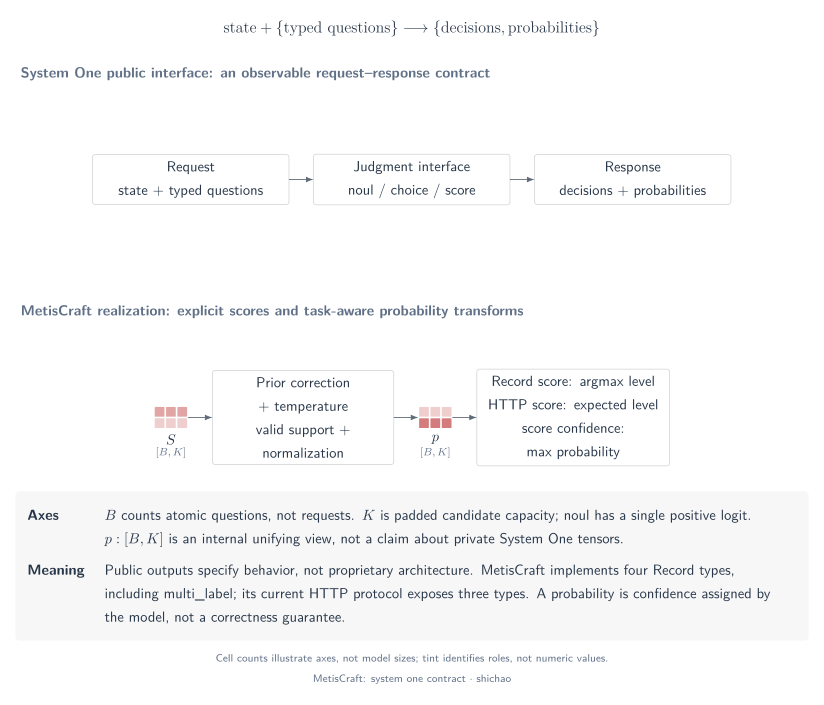
The System One API reference defines named questions over shared state. This chapter uses that contract to explain MetisCraft; it does not infer Jev's private layers, training method or execution kernels. Official documentation was checked on 2026-11-09.
Tensors and semantics
One HTTP request can contain several questions. MetisCraft converts each question to one Record, so the batch axis counts questions, not requests. A choice question with three options has three mutually exclusive outcomes; a multi-label question has one Bernoulli outcome per candidate.
| Object | Shape | Meaning of one entry |
|---|---|---|
| Token IDs \(X\) | \([B,T]\) | Vocabulary index at one token position |
| Padding mask \(A\) | \([B,T]\) | Whether a token position contains input rather than padding |
| Hidden states \(H\) | \([B,T,d]\) | A feature coordinate at one contextualized token |
| Candidate mask \(M^{\mathrm{cand}}\) | \([B,K_{\max}]\) | Whether that question has this candidate column |
| Readout scores \(S\) | \([B,K_{\max}]\) | An unnormalized score, not a probability |
| Valid probabilities \(P_b\) | \([K_b]\) | Probability of an option, level or candidate event |
See the notation and indexing guide for dtypes, ragged batches and the difference between padding, causal visibility and candidate validity.
Operator chain
MetisCraft follows this path:
request → Records → tokenization → left padding → backbone → readout → logit correction → temperature → typed probabilities → response
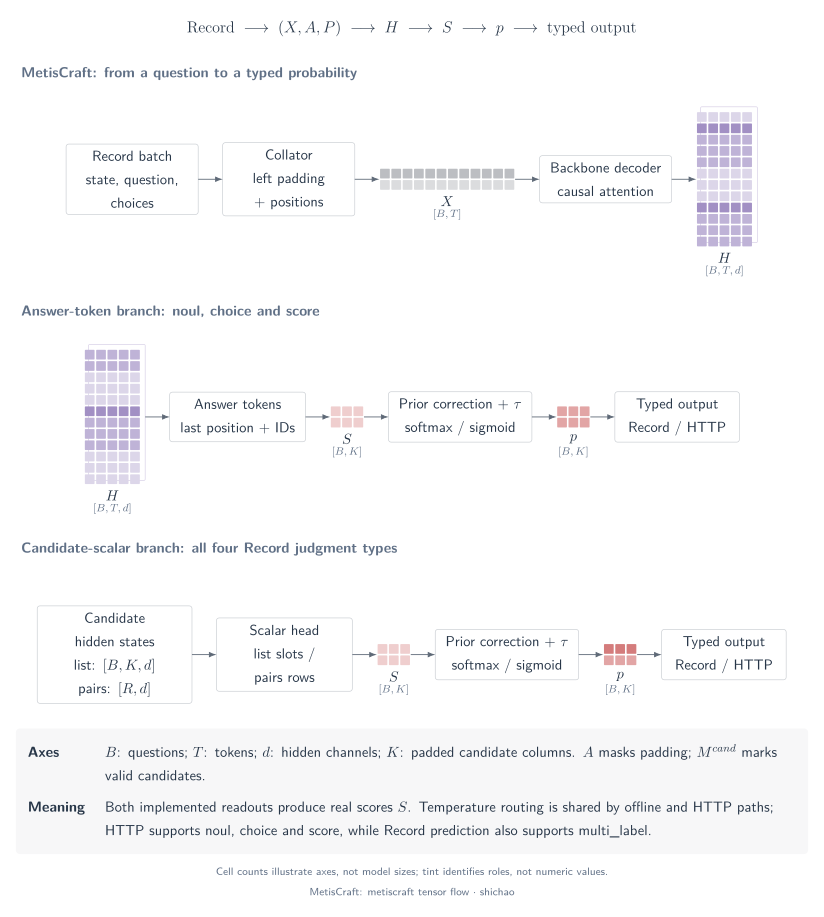
The backbone returns representations. The readout selects representations or vocabulary columns and turns them into scores. The judgment type determines normalization; the response adapter assigns the resulting values to stable answer IDs.
Equations
For question \(b\), let \(\mathcal K_b\) contain its valid candidate columns and let \(\tau_b>0\) be the selected temperature. Write \(\widetilde s_{b,k}=(s_{b,k}-\delta_b)/\tau_b\), where \(\delta_b\) is zero except for the configured multi-label positive-weight correction.
Softmax couples candidate probabilities through its denominator. Independent sigmoid outputs have no sum-to-one constraint; this does not imply that their hidden representations are independent.
Small example
The following values are constructed arithmetic, not a model-quality result. For three option scores \([0,1,2]\) and temperature \(1\), softmax gives approximately \([0.090031,0.244728,0.665241]\). A choice selects the third option. For ordered levels numbered \(0,1,2\), the same distribution has modal level \(2\) and expected score \(1.575210\).
| Judgment | Python / Record | /v1/systemone |
|---|---|---|
noul |
Probability of yes and a thresholded decision | Probability of yes |
choice |
Option distribution and selected ID | Option distribution and selected ID |
score |
Level distribution and modal level index | Level distribution and expected level index |
multi_label |
Independent candidate probabilities and selected IDs | Not supported in this version |
MetisCraft 0.1.0 returns maximum option/level probability as HTTP confidence. TypeSafe's documented confidence statistics differ. The training and calibration page gives the explicit comparison; no protocol change is implied by this chapter.
Source map
These explanations follow the toolkit implementation at commit 91259c6d07ece19248a02a4b56b43dd3a77d81e5.
| Stage | Inspectable implementation |
|---|---|
| Question-to-Record conversion | request_to_records |
| Token sequences and candidate indices | PromptBuilder |
| Padding and tensor batching | Collator |
| Answer-token and scalar readouts | DecisionModel.forward |
| Normalization and decisions | probabilities and decide |
| Calibration and response assembly | Predictor |
Scope and reading routes
MetisCraft implements two readout families and three execution paths: answer-token, scalar list, and scalar pairs. The seven-family comparison also explains mechanisms from the surrounding ecosystem; those diagrams do not add implementations to the package.
- Five-minute explanation: follow the guided walkthrough, reusing this chapter's diagrams and evidence.
- Implementation reading: notation → answer-token → scalar heads → training and calibration.
- First runnable application: use the CPU Cookbook.
- Measured model behavior: consult the Tev1 reproduction record; tensor arithmetic and random-model checks do not measure task accuracy.