Reproducing Tev1-4B
MetisCraft retrains a Tev1-style model using the public data builder and recommended recipe, checking data, prompts, per-question outputs and predeclared accuracy criteria. The 4B run meets those accuracy criteria; it does not recover the original weights or hosted training job.
The source is pinned to togethercomputer/tev1@1dde778, reviewed 2026-11-05. Original readout and per-question checks were completed 2026-11-07.
Model architecture
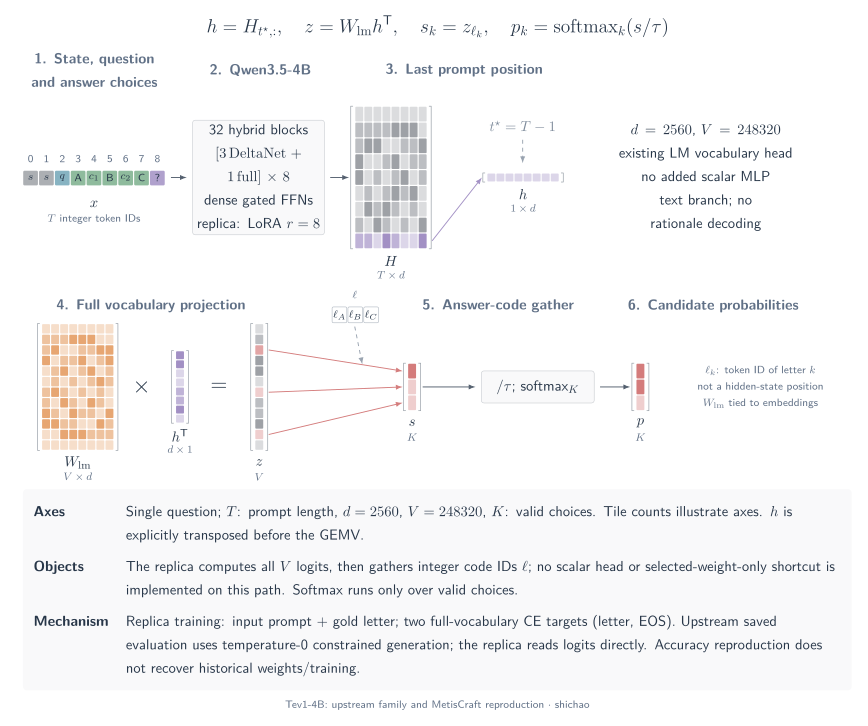
Tev1 fine-tunes Qwen3.5-4B for decisions, predicting answer letters with its existing LM head. The upstream description documents LoRA supervised fine-tuning; the pinned model card states that it retains the standard next-token output head. MetisCraft's 4B reproduction uses the same readout family.
| Component | Published architecture and this reproduction |
|---|---|
| Base | Upstream uses Qwen3.5-4B; this run pins Qwen/Qwen3.5-4B@851bf6e8 and uses its text causal-language-model branch. |
| Hybrid backbone | 32 layers, hidden width 2,560; groups of 3 Gated DeltaNet linear-attention layers and 1 gated full-attention layer, totaling 24 + 8; each layer includes a dense FFN. |
| Output projection | The existing LM head, tied to token embeddings, has vocabulary width 248,320; the readout is answer_token. |
| Tuning and objective | all-linear LoRA: r=8, alpha=16, dropout=0; non-thinking chat_json prompts; teacher-forced completion training applies full-vocabulary cross-entropy only to the answer letter and EOS. |
| Inference protocol | MetisCraft reads candidate-letter logits and normalizes over candidates; upstream saved results use temperature-0 generation constrained by an option regex. |
The upstream configuration and this run's base configuration are byte-identical; see the pinned Qwen model description for the layer layout. Matching configurations do not establish identical trained weights or recovery of the historical hosted job. LoRA settings follow the public recommendation; this run's recipe does not pack samples. The public configuration includes vision modules, but this experiment and MetisCraft's interfaces validate text tasks only.
Tensor objects and indices
The following describes our 4B inference implementation. \(B\) counts questions, \(T\) is the padded sequence length, \(K_b\) counts valid options for question \(b\), \(K_{\max}\) is the batch maximum, and \(V=248320\).
| Object | Type and shape | Meaning of one entry |
|---|---|---|
input_ids \(X\) |
int64, \([B,T]\) | A vocabulary ID in \(0\ldots V-1\), distinct from an option index. |
attention_mask \(M\) |
int64, \([B,T]\) | 1 marks a valid input token; 0 marks left padding. This is not a complete attention-probability matrix. |
| Final-position index \(t_b\) | Integer, conceptual \([B]\) index | \(\max\{t:M_{b,t}=1\}\); current left padding gives \(t_b=T-1\) for every row. |
| Hidden states \(H\), decision representation \(h\) | Floating point, \([B,T,2560]\), \([B,2560]\) | \(h_b=H_{b,t_b,:}\) is the final prompt position's contextual representation. |
| LM weights \(W_{\mathrm{lm}}\) | Floating point, \([V,2560]\) | Each row projects to one vocabulary token. |
| Vocabulary logits \(Z\) | float32, \([B,V]\) | \(Z=hW_{\mathrm{lm}}^{\mathsf T}\), before normalization. |
codes \(\ell\) |
int64, \([B,K_{\max}]\) | Vocabulary IDs for option letters; \(\ell_{b,k}\) maps a candidate column to a vocabulary column. |
Candidate mask \(C\) |
bool, \([B,K_{\max}]\) | True marks a valid candidate; its axes differ from the token-padding mask. |
| Candidate scores \(S\), probabilities \(p_b\) | Floating point, \([B,K_{\max}]\), per-question \([K_b]\) | Scores come from code columns; probabilities normalize only over the question's valid candidates. |
Operator chain and probabilities
State/question/all options → non-thinking chat template → left padding → hybrid causal backbone → final representation → full LM projection → gather letter columns → select valid candidates → softmax
The matrix product contracts the hidden axis: \((B\times2560)(2560\times V)\rightarrow B\times V\). Current DecisionModel.forward computes the complete vocabulary logits before gather; H[:, -1] implements the final-valid-position selection above. The collator derives position_ids from cumulative valid-mask counts, so left padding does not advance valid-token positions. Prediction removes padded candidate columns by valid count before normalization. The candidate-space denominator includes only valid answer codes and generally differs from the letter's full-vocabulary softmax probability.
All candidates share one causal prompt: earlier options cannot read later options, while the final answer position can read the preceding prompt. Reordering options can change contextual representations and logits; the shared softmax denominator also couples candidate probabilities.
Teaching example: valid logits \([0,1,2]\) give \([0.090031,0.244728,0.665241]\) at \(\tau=1\), and \([0.186324,0.307196,0.506480]\) at \(\tau=2\). Positive temperature preserves the highest-scoring candidate while changing the distribution. These constructed numbers are not measured Tev1 results.
Training objective and inference readout
completion training appends the correct letter as input and applies the LM head to \(H[:, -2:]\), producing \([B,2,V]\) logits for the answer letter and EOS. Loss averages the full-vocabulary cross-entropy at those two positions. Inference appends no target: it reads the final prompt position and normalizes over the candidate subset. See Collator and completion_loss. Candidate-space CE and this recipe's completion objective are therefore distinct.
See the existing diagrams and derivations in answer-token tensor analysis and training, calibration and output. The upstream request code additionally specifies constrained generation, the non-thinking template and logprobs parameters. A shared readout family does not establish identical serving protocols, calibration or latency, or reveal Jev's undisclosed internal architecture.
Results against the original
| Set | MetisCraft 2B | MetisCraft 4B | Original Tev1 4B | 4B difference |
|---|---|---|---|---|
| Main, 1,000 questions | 864/1,000 · 86.4% | 873/1,000 · 87.3% | 880/1,000 · 88.0% | −0.70 pp |
| Policy transfer, 300 questions | 276/300 · 92.0% | 298/300 · 99.33% | 300/300 · 100% | −0.67 pp |
Criteria were fixed on 2026-11-06 before observing results: 2B main accuracy within 5 percentage points of the original, transfer close to 100%; 4B accuracy within 2 percentage points. Only the 2B main check passed; both 4B checks passed without changing thresholds.
These public questions were used during development; they are not untouched final tests. The upstream separately labeled v2 final evaluation was not used here.
Per-question agreement
All 1,300 IDs, inputs, gold labels, candidate contents and order matched. Main answers agree on 946/1,000 (94.6%); transfer answers agree on 298/300 (99.33%). On main: both correct 852, only MetisCraft correct 21, only original correct 28, both wrong 99. No additional agreement threshold was introduced after observing results.
Main choice accuracy is 822/900 (91.33%), versus 828/900 (92.0%) upstream; SST-5 is 51/100 (51.0%), versus 52/100 (52.0%). The 2B SST-5 result is 57.0%, so larger size did not improve every component.
Probabilities and calibration
| 4B metric | Raw | Temperature calibrated |
|---|---|---|
| Main question-weighted NLL | 0.3019 | 0.3035 |
| Policy-transfer NLL | 0.0522 | 0.0990 |
Policy temperature is 0.476. Positive temperatures preserve these argmax decisions, while NLL worsens; this is not evidence of universal calibration improvement. For 2B, main-choice ECE is 0.027→0.019; transfer NLL is 0.20→0.44 with temperature 0.27. Its cause remains undetermined.
Conditions and training differences
The 4B run 20261106-183017-f4cb8155 uses the 4B recipe, tev1/rev-1dde7782, and Qwen/Qwen3.5-4B@851bf6e8 on one RTX 3090. Its 1,052 optimizer steps took 22,620.72 seconds (about 6 hours 17 minutes). The sealed source manifest SHA-256 is 00db1319eec8a5e936da53dc55f1ef57c23dfae9c1e8e196bacce28227d16d1b; artifact/calibration checksums and parent-artifact binding passed.
The 2B run uses Qwen/Qwen3.5-2B@15852e8c, completing 1,052 steps in about 7.2 hours with approximately 6 GB peak memory. Resource measurements describe that configuration, not arbitrary hardware or sequence lengths.
| Setting | Public upstream recommendation | MetisCraft |
|---|---|---|
| Base | Qwen3.5-4B | Pinned 2B control and 4B |
| Tuning | All-linear LoRA, r=8, alpha=16, dropout=0 | Same |
| Optimization | 1 epoch, 5e-5, cosine, warmup 0.03, gradient clip 1 | Same recommended values |
| Length | 2,048, packing | 2,048, no sample packing |
| Batch | 8 packed sequences, approximately 36 questions per step | batch 4 × grad_accum 9, target 36 questions per step |
| Objective | Answer letter and EOS only | Full-vocabulary completion |
| Prompt | Non-thinking chat template, system prompt and JSON | chat_json, all 43,708 prompts token-identical |
The hosted Together job ID, upload hashes and actual hyperparameters were not retained; historical-job retrieval returned 403. The repository explicitly supplies a recommendation. Agreement above is with that recommendation.
The original evaluation.json reports 88.0% / 100% using temperature 0 with option-regex-constrained generation. MetisCraft chooses the largest candidate-letter logit. These are not the same unrestricted full-vocabulary first-token protocol; unrestricted diagnostics were not performed.
Historical sample consumption and configuration identity
37,840 records at batch 4 produce 9,460 microbatches. The old loop filled 1,052 complete optimizer steps by reading 8 microbatches from the next epoch: 32 additional sample presentations, not 32 new independent examples. This agrees with historical epochs_seen=2. The current loop submits the remaining tail within the configured budget. This documentation work does not rerun the experiment.
Historical config.sha256 / recipe_sha256 identify the recipe before path resolution, while saved config.yaml is resolved. The original input hash can be reconstructed from the frozen recipe and recorded overrides. Current software records both identities; historical files and evaluation numbers remain unchanged.
Rebuilding data and prompts
| Source | Training records | Pinned version |
|---|---|---|
| MultiNLI | 5,000 | nyu-mll/multi_nli@da70db2a |
| BoolQ | 3,000 | google/boolq@35b264d0 |
| Banking77 | 3,000 | legacy-datasets/banking77@f5412156 |
| AG News | 1,500 | fancyzhx/ag_news@eb185aad |
| SST-5 | 2,000 | SetFit/sst5@e51bdcd8 |
| Synthetic policy decisions | 13,500 | Deterministic generator |
| Priority routing | 6,000 | Deterministic generator |
| Synthetic research classification | 3,840 | Generator and taxonomy |
Training contains 37,840 records, 16,929,529 tokens and maximum length 1,526 tokens; new-v1 dev contains 4,568 records. Synthetic data comes from rules/templates, without teacher models or Jev outputs. Source rows retain individual terms; artifacts trained on the mixture are not marked commercially usable.
pip install -e ".[reproduce]" flash-linear-attention
metiscraft data prepare tev1
The external builder pins the source tree and five upstream data versions. A wrapper provides local inputs with Hub access disabled; four build scripts and three verification scripts run unchanged before Record conversion. State-key and option order are preserved. All 21 public hashes match: 7 new-v1 final files, 12 intermediate files and 2 evaluation sets. All 43,708 records reconstruct their original messages.
| MetisCraft split | Source | Count |
|---|---|---|
| train | new-v1 train | 37,840 |
| calib, dev | new-v1 dev, split in half by group hash | 2,448 + 2,120 |
| test | v1 test | 1,000 |
| eval_only | v1 policy_transfer | 300 |
Fitting and evaluation inputs/groups do not overlap; deduplication removed no rows. SST-5 becomes score; other tasks become choice. BoolQ preserves its two lettered upstream options, with its original type in provenance. task_id=tev1/<source> separates calibration and reporting by source.
The builder uses Python 3.11, datasets 5.1.0 and transformers 5.22.1, versus upstream 3.12 / 4.8.5 / 5.17.0. Explicit Qwen2Tokenizer restores upstream counts: newer tokenization counts 2 / 8 fewer tokens in two BoolQ passages containing Devanagari / Tamil combining marks. This changes count hashes in three train files, not prompt text. Training still tokenizes using the base model's own tokenizer.
Conclusion and limits
The evidence supports predeclared accuracy reproduction on the same public questions and similar per-question behavior. It does not establish identical weights, recovered historical training or generalization to untouched tasks. Single-seed, readout-protocol and calibration limitations remain. See the Tev1 recipe for setup and training, calibration and output for the mechanism.